EMCARE SUPPORT PLATFORM
Improving the emergency room experience through information and emotional support

Overview
Objectives
Understand the emotional and informational needs of patients and relatives in ER contexts
Identify pain points across the patient journey
Design a solution that improves communication, transparency, and emotional support
Explore the use of AI-driven interactions to assist users in real time
Context and Problem
Emergency rooms are highly stressful environments where patients and their relatives often experience uncertainty, lack of information, and emotional distress. Communication is limited, waiting times are unclear, and users feel disconnected from the care process.
EMCare was developed as a master’s project, focusing on improving the experience of patients and their companions in emergency departments through digital and service design interventions.
Research & Design Process
Approach
To understand the complexity of the emergency room experience, I combined qualitative research, journey mapping, and service design tools.
User interviews with patients and relatives to capture experiences and expectations
Contextual analysis of emergency room dynamics and workflows
Journey mapping to identify critical pain points across different stages
Service blueprinting to understand interactions between users and healthcare staff
Key Insights
Uncertainty amplifies stress
Not knowing what is happening or how long it will take increases anxiety significantlyInformation is fragmented and inconsistent
Users receive partial or unclear updates, leading to confusion and frustrationRelatives feel excluded from the process
Companions often lack access to information and emotional supportHealthcare staff are overloaded
Communication gaps are not intentional, but a consequence of system pressure
Design Decisions
Centralize information → create a clear communication system
Provide real-time updates on status, waiting times, and next stepsSupport emotional needs → integrate conversational assistance
Use AI-based chat to guide users and reduce uncertaintyDesign for both patients and relatives
Ensure both roles have access to relevant information and supportAlign with hospital workflows
Propose a solution that complements existing systems without adding friction
Outcome
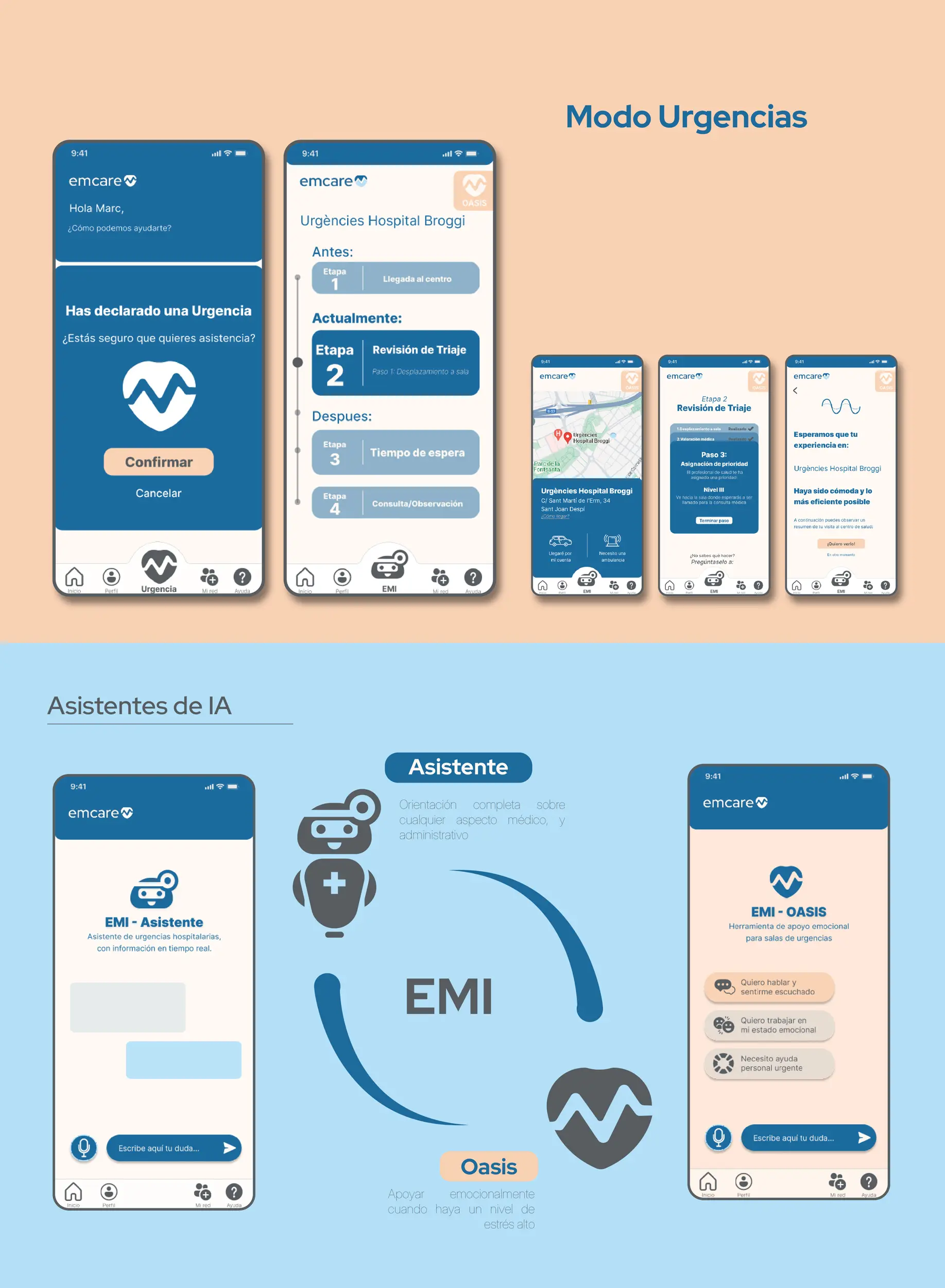
EMCare is a digital service system designed to improve the emergency room experience through clear communication and continuous support.
Key components:
Patient-facing interface
Provides real-time updates, process visibility, and guidanceConversational assistants (AI-based)
Two chat systems designed to answer questions, explain processes, and offer supportService integration
Designed to fit within existing hospital workflows and communication channels
Impact and Learnings
EMCare proposes a shift from fragmented communication to a more transparent and user-centered emergency care experience, improving both emotional and informational dimensions.
Designing in healthcare requires balancing user needs, system constraints, and ethical considerations, especially when integrating AI into sensitive contexts.